A Newer World
Parsifal, Odysseus and the arithmetic of striving

To strive, to seek, to find, and not to yield.
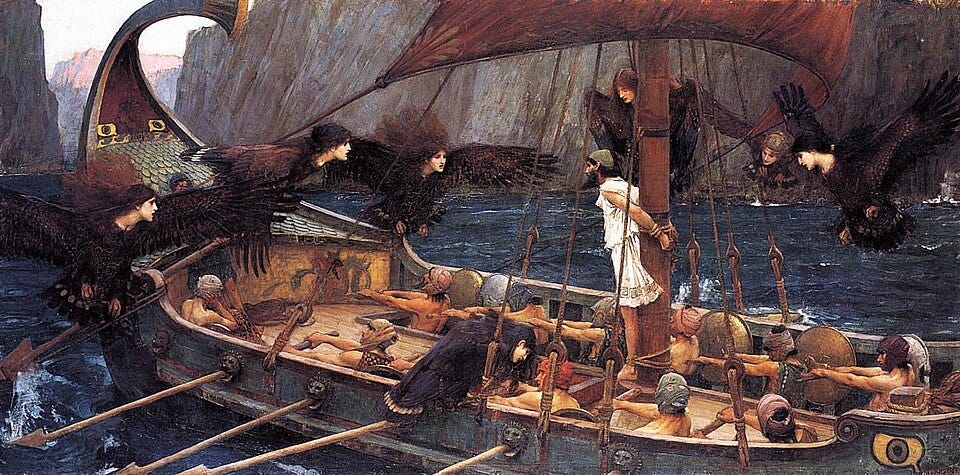
The words come from Tennyson rather than Homer, but as a summary of what we’ve distilled from three thousand years of The Odyssey, they work pretty well. We revere it as a story of travel and trial, about a man tested again and again until every obstacle is overcome and his goal is won. It is the archetype for the ‘hero’s journey’, so beloved of fantasy films, tech entrepreneurs and self-help books. We have boiled away the supernatural until all that’s left is the stubborn residue of striving.
And it’s no surprise that the story still holds such power. We live in a world where we are told that nothing will be handed to us. That we must shape the future we want to inherit and earn the kind of life we desire. The Odyssey’s moral logic feels uncannily at home in a culture that demands everything while promising nothing. The dangers and temptations that might divert us map neatly to Homer’s spells and sirens and monsters. The lesson is clear: master yourself, resist, endure. Only then can you have the things you truly want.
Over the past decade, celebrating failure has become an important social ritual, with liturgical materials supplied by a single, misunderstood line from Beckett’s Worstward Ho! and a subscription to the Harvard Business Review. But even this most modern fixation has an Odyssean quality. If you look beyond the formula of humble trial and error, you’ll notice that the post-mortems are only ever issued from an existing peak of success. The embarrassments, the shame, the true losses never get a preening blog post. Failure is only celebrated as noble by the winners.
It’s against this backdrop that Christopher Nolan’s film and Emily Wilson’s translation have become lightning rods for every sort of grievance. The arguments themselves are revealing. Shorn of its gods and concentrated into secular myth, The Odyssey can tell whatever story you like. It is a manifesto for manhood, a reckoning with both the value and cost of beauty, a reassurance that whatever you have is what you have earned.
But for all the cost in men and blood, the consolation of Odysseus’ return has always struck me as false. After the fall of Troy he sails for Ithaca with a company of around six hundred men. A decade later, he is the only survivor. The poem gives those men voices and grieves when they are lost. But we read them now as narrative fodder: the many failures by which Odysseus’ sole success is given meaning.
One of the first short stories I ever wrote was about a man watching Apocalypse Now and reflecting on the chances of being the only soldier whose slalom run through the jungle doesn’t end in a bullet or an arrow. Looking back, I think I was already anticipating the improbable sequence of luck it would take to give me all the things I thought I wanted. And that’s the real lesson I draw from The Odyssey. Not that the heroic make it home, but that the statistics are never in our favour.
But while Homer’s nostos has been co-opted, there is another great journey in Western art that evades such cosy pieties—that of Wagner’s Parsifal. As characters, Parsifal and Odysseus couldn’t be more different, the holy fool and the wily king. However, as protagonists, they have quite a lot in common. Their stories begin with them being conscripted in service of a great purpose. They accomplish that purpose, albeit at great cost. Then they set out to return. And on the surface, Parsifal’s long period of wandering between the opera’s second and third acts does resemble The Odyssey. He has been cursed by Kundry rather than Poseidon, though it’s to much the same effect: he will not find the destination he seeks. After that, the similarities end.
Instead of dramatising the years of cursed journeying, Wagner simply ignores it. No more trials are recounted, nothing else is plucked from Wolfram von Eschenbach’s poetic bestiary. It all happens off stage, alluded to only in the sombre pulse of the third act prelude and a brief summary mention of dangers, battles and conflicts. Parsifal wanders and—at last—is not lost, finding Gurnemanz and Kundry in a spring meadow at the start of Act III, unaware that it is Good Friday. From there, grace moves with its own momentum until the Grail is uncovered and the land and the king are healed.
This is characteristic of the opera as a whole. It dramatises—at length—what it holds to be important and excludes what it doesn’t; even when it requires rejecting both Western storytelling tradition and its own source material. Wagner resists detailing Parsifal’s odyssey not out of narrative economy, but simply because it is irrelevant to the opera’s redemptive arc. And it is the nature of this redemption that sets the opera apart.
Within the metaphysics of Parsifal, redemption is something we receive and not something we earn. Grace, like love and forgiveness, can only be given. The actual length of Parsifal’s wandering is never counted, because it is not the accumulation of years and scars that makes him worthy. He may not even be worthy; at least not in the way that a strung bow, a line of axes and a room of dead suitors might suggest. The opera’s pivotal moment, when Parsifal resists Kundry’s strange, maternal seduction, can be read several ways—as a moment of profound empathy, an exercise of self-control, or a sudden spiritual awakening—but whatever it is, it is not the castle-storming climax of a man of action. Instead it arrives as a non-sequitur; the recognition of another’s pain, received unexpectedly on the cusp of great pleasure.
But the opera doesn’t just reject striving by what it omits. The villain Klingsor is an inversion of the Odyssean archetype. He yearns to join the brotherhood and serve the Grail, even castrating himself in order to exorcise his desire and prove himself worthy. In that sense, he reads as thoroughly modern (and eminently employable). But purity is not a product of effort; his sacrifice is wasted and the knights reject him. Holiness cannot be willed and salvation cannot be summoned through self-mastery.
I suspect that the reason Parsifal resists such simple moral distillation is the same reason that its reputation remains so contested. The opera inspires both devotion and loathing from people who experience its near five-hour duration as somewhere between a pensioner’s rambling and the unfolding of a flower. Length aside, a major factor in this is the opera’s elusive, magpie theology. Beneath Christian vestments sit competing strands of ascetic Buddhism and Schopenhauerian searching that never comfortably cohere, let alone resolve into a single interpretative key. The opera is a mass interrupted by a mutilated wizard, a purgation interrupted by the Karfreitagszauber’s sudden beauty, an instrument of will interrupted by absolution and heavenly descent. For some that ambiguity is an intolerable confusion, for others it is the sort of alembic from which grace might plausibly emerge. But either way, it is this syncretism that allows Parsifal to resist the kind of functional readings to which it might otherwise fall.
Parsifal denies us the consolations of self-improvement and earned success. The worldview it espouses is unknowable, divine in a way that makes Homer’s querulous, capricious gods seem almost human. So what are we to draw from it? I think the answer is simple: reprieve. Parsifal sits softly with the truth that what we are given is seldom what we deserve, and that grace, if it comes to us at all, comes unbidden and at a time of its own choosing.
Which is not to say that we will be saved from wandering. That much is, unfortunately, inevitable. But like Parsifal, for most of us it won’t look like inexorable, earned progress towards the place we most desire. Instead it will arrive suddenly, without our knowing.
Tennyson’s poem imagines an old Odysseus, still striving as the last light fades. Even in old age he cannot stop. Can any of us? As an unapologetic piece of Homeric distillation, there’s no doubt which tradition Ulysses belongs to. But perhaps that doesn’t matter. After all, there is no telling where grace might choose to descend.
Come, my friends, ‘tis not too late to seek a newer world.